Individualism in the United States: A Transformation in American Political Thought by Stephanie M. Walls
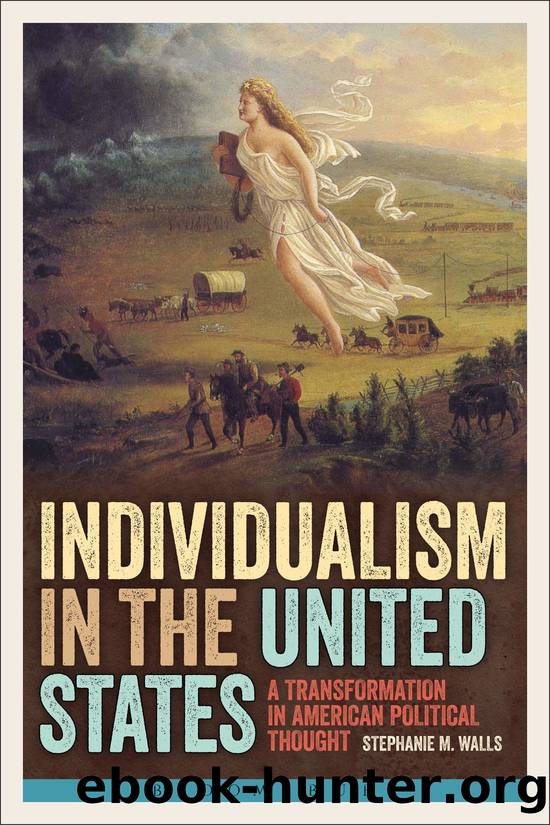
Author:Stephanie M. Walls [Walls, Stephanie M.]
Language: eng
Format: epub
ISBN: 9781501310058
Google: s88EzgEACAAJ
Goodreads: 20757469
Publisher: Bloomsbury Academic
Published: 2015-02-26T00:00:00+00:00
Figure 5.1 The transformation of political individualism into economic individualism.
First, the economic development of the nineteenth century redefined how citizens perceived themselves individually and socially. Prior to this time, individual interests were at least partially advanced through the practice of self-restraint and the societal stability this contributed to. However, industrialization and the expansion of capitalism required individuals to take risks with their resources, their livelihoods, and even their own lives. Those who had more resources to spare were rewarded through their speculations and investments. Those who were willing to take greater risks stood to benefit the most. Exercising self-restraint and caution could result in being left behind during this era of rapid progress. Likewise, those individuals with fewer resources who were looking for jobs were encouraged to put themselves first by leaving their communities and moving to urban areas where jobs were more plentiful. As competition for jobs increased, individuals could suffer loss of both opportunity and money if they stopped to consider the wellness of another. The smarter approach in this climate was to run headlong in the direction of opportunity lest another got there first. This desire undermined a key component of the societal bonds that individualism requires by discouraging self-restraint.
Insofar as the individualâs economic success seemed to hinge on competition and the absence of self-restraint, people began to identify as individuals rather than as part of a group. Individual autonomy now required physical separateness and independence and a willingness to not conform to the norms of the group.41 Historically, self-restraint was valued and necessary to preserve oneâs role in society (and thus buttress individual freedoms and rights), but with self-restraint devalued, the role of the individual in society changed as well. Society was no longer perceived as a way to protect the freedoms and rights of the individual, but as a threat to the individual. The state would force conformity, and this new individual wanted to do whatever he or she thought was good for him or her in the realm of economics and beyond. The sociology literature has documented a number of social implications for this changing mentality including a general withdrawal from other-interested activities.42
Second, economic development introduced a level of economic instability and insecurity that resulted in increased economic dependency and a more defined class structure. This component of the transformation is heavily based on Karl Marxâs understanding of capitalism. Critics of capitalism have repeatedly noted that the cyclical nature of this type of economic system creates periodic economic crises. Rapid industrialization combined with a capitalistic allocation of resources created a great deal of instability for a large portion of the population, most notably those with fewer resources.
Basically, as more people went to work for others (instead of providing for themselves through agricultural work), more people suffered the negative effects of the economic system. An increasing number of people were subjected to these cyclical fluctuations, and the haves and have-nots became connected in an economic relationship of mutual dependency. People were sold on the idea
Download
This site does not store any files on its server. We only index and link to content provided by other sites. Please contact the content providers to delete copyright contents if any and email us, we'll remove relevant links or contents immediately.
The Secret History by Donna Tartt(19086)
The Social Justice Warrior Handbook by Lisa De Pasquale(12190)
Thirteen Reasons Why by Jay Asher(8909)
This Is How You Lose Her by Junot Diaz(6886)
Weapons of Math Destruction by Cathy O'Neil(6279)
Zero to One by Peter Thiel(5801)
Beartown by Fredrik Backman(5754)
The Myth of the Strong Leader by Archie Brown(5507)
The Fire Next Time by James Baldwin(5442)
How Democracies Die by Steven Levitsky & Daniel Ziblatt(5218)
Promise Me, Dad by Joe Biden(5153)
Stone's Rules by Roger Stone(5087)
A Higher Loyalty: Truth, Lies, and Leadership by James Comey(4962)
100 Deadly Skills by Clint Emerson(4925)
Rise and Kill First by Ronen Bergman(4788)
Secrecy World by Jake Bernstein(4753)
The David Icke Guide to the Global Conspiracy (and how to end it) by David Icke(4717)
The Farm by Tom Rob Smith(4507)
The Doomsday Machine by Daniel Ellsberg(4490)
